Wednesday, July 13, 2016

18 Week Chin Up & Dip Program For An Impressive Upper Body


18 Week Chin Up & Dip Program For An Impressive Upper Body
Chin ups and dips are 2 overlooked but important bodyweight exercises. This 18 week workout protocol features a single training day dedicated to these movements.

WORKOUT SUMMARY
Main Goal : Build Muscle
Workout Type : Single Muscle Group
Training Level : Beginner
Days Per Week : 4
Equipment Required : Bodyweight, Other
Target Gender : Male & Female
Author : Raazu Thapa

WORKOUT DESCRIPTION

What would you say if I told you that two moves could drastically change the way your upper body looks and feels?  What if I told you that those two moves have been around since the dawn of training and offer excellent results?

You would probably think it sounds like the standard fitness sales pitch.  But, what I am about to tell you is definitely 100% true.  Chin ups and dips are the keys to building a complete upper body.

Prioritizing Chins and Dips
In today’s get fit quick society, no one wants to put in the hard effort to become what they desire to become.  Many males desire to have a full and ripped upper body.  The problem is that many males want to take shortcuts to try to achieve that goal.

Lame workout design, too much volume, and avoiding progressive overload are the three biggest causes for concern.  The typical meathead routine of flat bench, incline bench, decline bench, horizontal machine press, dumbbell fly, and cable crossover all in the same day with a ridiculous amount of volume is not the answer for the complete upper body.
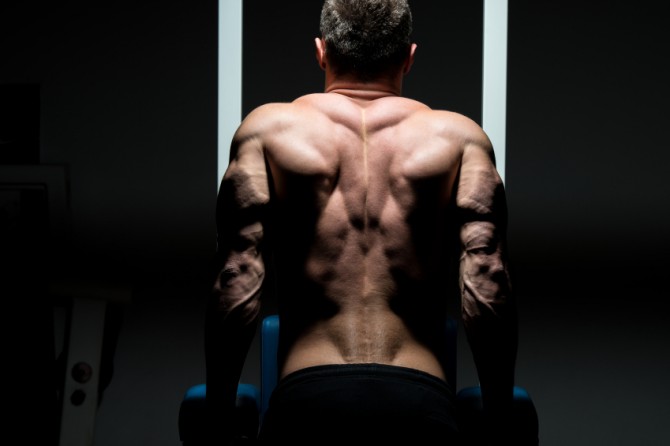
When you add in way too many drop sets and forced reps into oblivion, you have the recipe for total disaster.  I know many folks who perform this routine weekly and have nothing but a wide, unsculpted chest to show for it.  It is absolutely appalling.

I love to study other disciplines in the world of athletics.  Every sport has a bodypart that stands out due to the training used in that field.  Sprinters have the greatest hamstrings and glutes on the planet.  Speed skaters and sprint cyclists have quads that put some bodybuilders to shame.  And male gymnasts have supreme, superhero like upper bodies! And from what I know these guys are doing a lot of upper body pushing and pulling namely a great, great amount of chinning and dipping variations.

In my opinion chins and dips are the ultimate moves for the upper body.  Chins and dips have always been a staple of my training but normally as part of a training session.  The new thought in my brain early last year was what if I dedicated a separate day to only chins and dips?  The mere thought of this had me fired up like Ray Lewis during the pre game.

The results were astounding.  I programmed the chins and dips into my training as a separate day and before I knew it, I had developed a thicker and fuller upper body.

Hitting chins and dips with heavy weight offset with high volume forced me to grow.  A thicker chest, a much wider back, and larger arms were all a result to this programming change.  The frequency of doing them as a separate day combined with my training protocols plus the progressive overload had my upper body growing like Rocky’s beard in Russia.

I also noticed that as my chins and dips became stronger, my other pressing and pulling moves were getting stronger too.  But enough about me because now it is time for you to grow.

Below I will outline a basic 18 week chin and dip protocol to get you going in the right direction.  And please remember this very important fact.  A lot of phony fads in the game today promise you some unbelievable results in a very limited block of time.  4 week abs, 60 days to a massive chest or similar gimmicks.  I am not about that and I do not stand for it.

Real results take time and effort.  What I will promise you is this though.  If you follow this chins and dips and protocol, you will be stronger and more muscular in your upper body at the end of 18 weeks.  I do not know how dramatic the results will be because everyone responds differently and everyone’s nutrition will be different.  But you will be better, believe that.

Overview
You will perform your chins and dips as a separate day each week for 18 weeks.  On that day you will only perform chins and dips.  The scheme will be a basic Legs-Push-Pull split.  Your training week will look like this:

Monday - Chins and Dips
Tuesday - Legs
Wednesday - Off
Thursday - Push
Friday - Pull
Saturday - Sprints or Off
Sunday - Off
The Training Scheme
You will need to purchase a dip belt so make that a priority and get one.  Remember, progressive overload is a very important key to making great gains.  We are not doing all the difficult movements that gymnasts perform daily so our challenge has to be adding more weight or working faster.

Once you can complete the whole day without a missed rep, it is time to move up in weight.  Doing bodyweight dips for 5×10 for three weeks makes you Anderson Average.  You do not want to be the run of the mill stagnant lifter.

For the first three weeks you will use a basic 5×5 training scheme for your chins and dips.  Remember with 5×5 you have two options.  You can increase the weight slightly each set, or use the same weight for each round even if it starts off as bodyweight.

For the second three weeks you will use more volume and use a basic 5×10 scheme.  Again you can increase the weight slightly each set, or use the same weight for each round even if it is bodyweight.  You will also be performing the moves as a superset but with a slightly longer rest than a typical superset.

For the 5×5, after you start with your chins, you will rest 1 minute before performing the dips and then rest 2 minutes before starting the rounds over again.  For the 5×10 you will rest 45 seconds before performing the dips and then rest 90 seconds before starting the rounds over again.

The third scheme of the phase will be performing the chins and dips RP-21 style with the 7×3 and 6×5 schemes.  Please refer to my article on RP-21 for a detailed explanation of RP-21.

Week 1-3 - 5×5 Chins and Dips, rest 1 minute between moves and 2 minutes between sets
Week 4-6 - 5×10 Chins and Dips, rest 30-45 seconds between moves and 60-90 seconds between sets
Week 7-9 - RP-21 Chins and Dips, use the 7×3 and the 6×5 scheme on the same day.  Perform the Chins 7×3, rest 2-3 minutes and then perform the Dips 7×3.  After the dips rest 2-3 more minutes before performing the 6×5 chins.  Rest 2-3 minutes and then perform the 6×5 dips.  Please refer to my RP-21 training scheme for the details of the 7×3 and 6×5 sets.
Week 10-12 - Repeat week 1-3, but with heavier loads
Week 13-15 - Repeat week 4-6, but with heavier loads
Week 16-18 - Repeat week 7-9, but with heavier loads
Conclusion
Simplicity is the key to life.  When things are made supremely complex, the natural human nature is to lose focus and eventually quit.  With this simple scheme here you can begin to improve your upper body.

Chins and dips are basic movements that are thee go-to movements for the upper body.  All you need to do is simply record your weights/reps and move forward.

Eat accordingly to your goal whether it is to lose fat or gain muscle mass.  And if you train hard enough, you too may develop that superhero upper body.  But also make sure you definitely have the solid wheels to match the upper body.

People fear and respect a character like Batman.  He has a balanced and imposing superhero physique.  People laugh at a character like Johnny Bravo.  His legs were used as pipe cleaners for my kitchen pipes last week.  Keep it simple and make progress!

Head-To-Toe Training In Under An Hour


Head-To-Toe Training In Under An Hour

When you're looking for a great workout that's high in intensity but short on time, nothing beats total-body training. By using everything in your (gym) bag of tricks—compound movements, plyometrics, supersets, giant sets, and functional training—you can hit every muscle group, get your heart pumping, and obliterate mega calories. The best part? You'll be in and out of the gym in under an hour. Integrate these routines from top NLA for Her athletes into your workout to get in peak condition this summer.

1 SUPER-DUPER SETS
To boost intensity while amping her calorie burn, IFBB pro Caryn Paolini uses several advanced training techniques within a single total-body workout. By reducing rest intervals with supersets and trisets, she's able to keep her workouts fast-paced and her training intense. After a brisk, dynamic stretch, Paolini kicks off her workout with 5 sets of 15 reps for both stationary lunges and dive-bomber push-ups. The stationary lunges target her quads and hit her glutes, calves, and hamstrings. Dive-bomber push-ups target her entire body while dynamically building both strength and flexibility in her chest, shoulders, and triceps.

After getting limber, Paolini gets into the meat of the program, kicking things off with a superset that hits both her upper and lower body and keeps her heart rate elevated for the entirety of the workout.

Paolini also loves to include plyometrics in her once-a-week total-body programming to improve endurance, save time, and burn calories. "Plyometrics are a great alternative to cardio—something to do rather than jumping on a boring machine," she says.

SUPER-DUPER SET WORKOUT 
WARM-UP 1
DYNAMIC STRETCHING

BODYWEIGHT REVERSE LUNGE
5 sets of 15 reps per leg

DIVE-BOMBER PUSH-UP
5 sets of 10-15 reps

SUPERSET 2
DUMBBELL THRUSTER (SHOWN W/ KETTLEBELLS)
4 sets of 15 reps

JUMP SQUAT
4 sets of 20 reps, rest 60 sec.

TRISET 3
CABLE ROPE PRESS-DOWN
4 sets of 15 reps

CABLE ROPE BICEPS CURL
4 sets of 15 reps

BURPEE
20 reps, rest 60 sec.

SUPERSET 4
BARBELL STEP-UP
4 sets of 15 reps

JUMP LUNGE
4 sets of 15 reps, rest 60 sec.

TRISET 5
WIDE-GRIP LAT PULL-DOWN
4 sets of 15 reps

CABLE LOW ROW
4 sets of 15 reps

BENCH DIP
4 sets of 20-25 reps

SUPERSET 6
KETTLEBELL SUMO SQUAT TO ROW
4 sets of 15 reps

LATERAL BAND WALK
4 sets of 20 steps per side

FINISHER 7
WALKING LUNGE
1 set, length of gym and back

SIDE WALKING LUNGE
1 set, length of gym and back

FROG JUMP
1 set, length of gym and back

COOL-DOWN 8
STRETCHING


FOAM ROLLING


2 PUMPED-UP CIRCUITS
Circuits are a popular total-body workout strategy because they increase the intensity of a workout through continual movement and shortened rest periods. NPC bikini competitor Theresa Miller loves putting her own twist on traditional circuit training. "Instead of doing one set of each exercise for four rounds, I do two sets of each for two rounds," says Miller. Her reasoning is twofold: Her muscles get a little more fatigued with two sets than they would with a single one—offering greater opportunity for change and adaptation—and each muscle group also gets a little more rest between sets, making it easier to go harder in the second round.

The extra energy is much needed. While Round 1 uses moderately challenging weight, Round 2 adds an extra challenge, boosts intensity, and makes the most of the short workout circuit by calling for heavier weights.

PUMPED-UP CIRCUIT WORKOUT 
WARM-UP 1
STAIRMASTER
10 minutes

CIRCUIT 2
BACK SQUAT
2 sets of 12-15 reps, rest 30 sec.

BARBELL WALKING LUNGE
2 sets of 12 reps, rest 30 sec.

JUMP SQUAT
2 sets of 12-15 reps, rest 30 sec.

PULL-UP
2 sets of 12 reps, rest 30 sec.

BARBELL SHOULDER PRESS
2 sets of 15 reps, rest 30 sec.

BURPEE
2 sets of 15 reps, rest 20-30 sec.

PUSH-UP
2 sets of 12-15 reps, rest 30 sec.

HIGH KNEE
2 sets of 20-30 seconds, rest 30 sec.

BICYCLE CRUNCH
2 sets of 25 reps, rest 30 sec.

PLANK
2 sets of 30-60 sec., rest 30 sec.

Note: Perform 2 sets of each movement, then circle back to the beginning and do another two sets of each move. That's 4 sets total.
COOL-DOWN 3
STAIRMASTER
20 minutes

STRETCHING
 
3 STRENGTH TRAINING AND HIIT COMBO
Even if you're a devout body-part traditionalist like fitness model Lais De Leon, you can still benefit from the occasional total-body workout. "Instead of only targeting a body part once a week, you have the opportunity to hit it twice," DeLeon says. "This potentially provides faster results."

Though she normally prefers straight-set training for hypertrophy purposes, DeLeon incorporates supersets on total-body days to save time. However, she always follows one rule: Keep cardio separate. "I never blend cardio into my total-body workout," she says. "It expends too much energy and results in less productive lifts." Saving time at the end for a solid HIIT session allows her to prioritize strength training and keep the focus on hypertrophy while still getting in a quality sweat session.

When gearing up for a hard workout, even a short one, it's important to fuel smart—before, after, and during a workout. "I always have Her Aminos intra-workout to preserve as much muscle as possible," DeLeon says. "Post-workout, I have a protein shake to promote protein synthesis."

STRENGTH TRAINING AND HIIT COMBO 
WARM-UP 1
DYNAMIC STRETCHING

 STAIRMASTER
10 minutes

SUPERSET 2
BARBELL SQUAT
4 sets of 12-15 reps

STIFF-LEGGED BARBELL DEADLIFT
4 sets of 10-12 reps, rest 1 min.

SUPERSET 3
DUMBBELL BENCH PRESS
4 sets of 10 reps

DUMBBELL FRONT RAISE TO LATERAL RAISE
4 sets of 15-20 reps, rest 1 min.

SUPERSET 4
EZ-BAR CURL
4 sets of 21 reps using 21 method*

CABLE ROPE PRESS-DOWN
4 sets of 20 reps, rest 1 min.

Note: Perform 7 partial reps in the bottom half range of motion, 7 in the top half, and 7 full reps without stopping.
CIRCUIT: 4 ROUNDS 5
PULL-UP
to failure

ASSISTED PULL-UP
8-10 reps

TOES-TO-BAR
to failure

HANGING KNEE RAISE
10-20 reps

HIIT MODALITY OF CHOICE
15-20 min., alternating 1 min. high speed, 1-min. active rest

COOL-DOWN 6
STRETCHING

 FOAM ROLLING

 4 ALL-IN-ONE CIRCUIT
IFBB figure pro Jessie Hilgenberg is known for her rigorous training routine, but sometimes even the most dedicated athletes need programming flexibility. "If I'm traveling, low on time, or know I won't be able to get in all my workouts that week, I opt for a total-body workout," Hilgenberg says.

After a solid warm-up, she begins her circuit by doing one set of 12 reps or following a set time for each exercise. The key is the limited rest she takes between sets. Keeping the turnover between exercises to under a minute keeps the intensity high. The quick transition also increases stimulation and, more importantly, prevents boredom. "Circuits like this allow me to push quickly and keep my muscles guessing," she says.

If she's really short on time, Hilgenberg cuts a few negative pull-ups from her program and doubles or triples the exercises into supersets and giant sets to get 'er done. At the end of each round, she throws in a cardio element to burn off a few more calories and finish strong. "I use jumping lunges or jump rope to get my heart rate up again," Hilgenberg says. "It also saves time, since I get my cardio and my lifting done at once."

ALL-IN-ONE CIRCUIT
WARM-UP 1
TREADMILL OR STAIR-CLIMBER
10 min.

CIRCUIT 2
PLANK
45-60 sec.

PULL-UP
10-12 reps

SUMO SQUAT, FEET ELEVATED ON STEP
12 reps

INCLINE DUMBBELL PRESS
12 reps

REVERSE LUNGE TO CABLE ROW
12 reps per leg

BARBELL CURL
12 reps

LATERAL DUMBBELL RAISE
12 reps

TRICEPS PUSH-DOWN
12 reps

ROPE JUMPING

Tuesday, July 12, 2016

10 Best Chest Exercises For Building Muscle

10 Best Chest Exercises For Building Muscle

Mind you, this list doesn't correlate to the hardest chest exercises. It's focused on the best-of-the-best mass builders, with a little bit of instruction and explanation to complement each choice. You can swap exercises in your current routine for these choices, build your own chest workout with a handful of them, or just try one when your standard chest workout gets stale.
Without further ado, here are our top 10 chest-building exercises, ranked in no particular order.
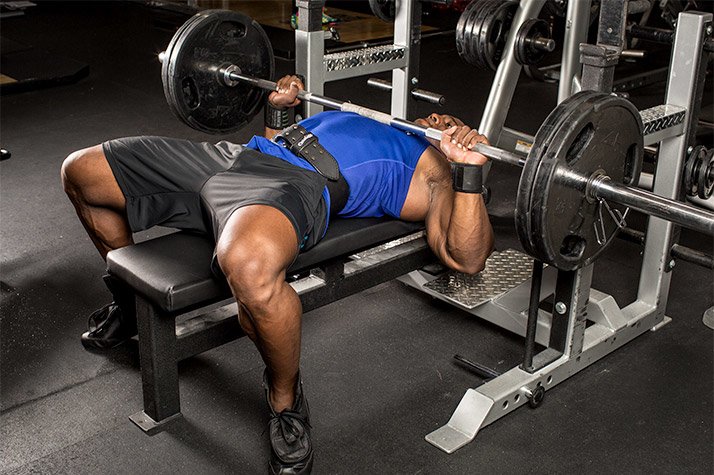
1 Barbell Bench Press
Why it's on the list: You can generate the most power with barbell lifts, so the standard barbell bench allows you to move the most weight. It's also an easier lift to control than pressing with heavy dumbbells. The exercise is easy to spot and relatively easy to learn (if not master), There are plenty of bench-press programs you can follow to increase your strength.

Barbell Bench Press
In your workout: Do it toward the start of your chest workout for heavy sets in lower rep ranges. Consider varying your grip width for more complete chest development.
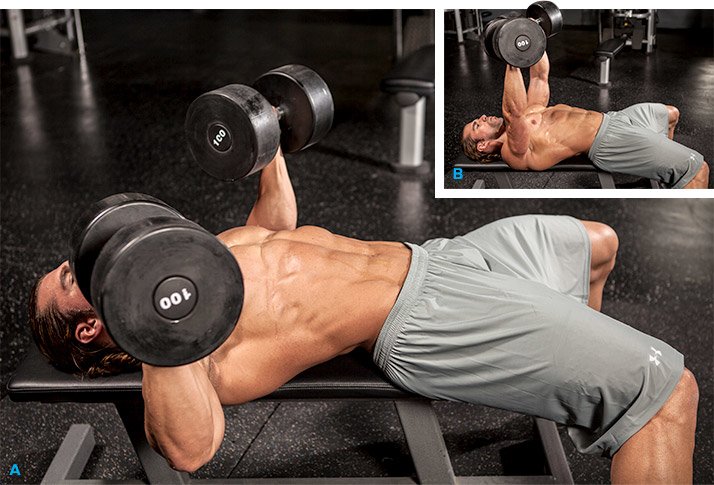
Flat-Bench Dumbbell Press
Why it's on the list: With dumbbells, each side of your body must work independently, which recruits more stabilizer muscles; dumbbells are harder to control than a barbell. Dumbbells also allow for a longer range of motion than the barbell bench press, both at the bottom and top of the movement. Flat dumbbell presses allow you to hoist a fairly heavy weight, and they make for a good alternative if you've been stuck on the barbell bench for ages.

Flat-Bench Dumbbell Press
In your workout: Do flat dumbbell presses toward the start of your chest workout for heavy sets in lower rep ranges. We don't typically recommend doing dumbbell presses in addition to the barbell bench press, because both moves are so similar.
In fact, the similar nature of these movements was confirmed via electromyography (EMG) analysis, which demonstrated no significant differences between flat-bench dumbbell and barbell in regard to muscle activation.
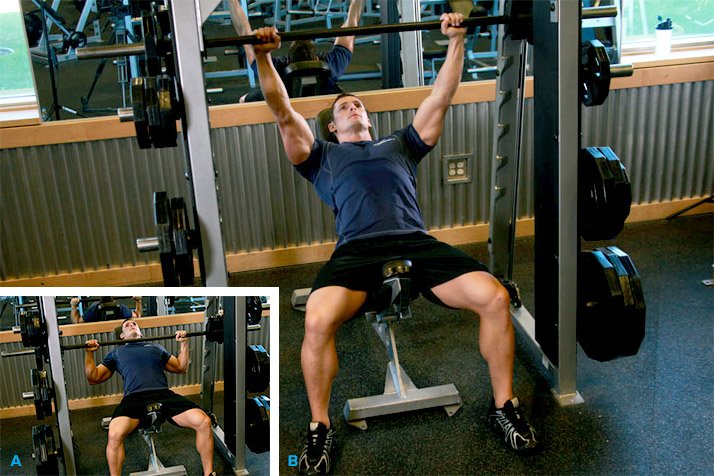
Low-Incline Barbell Bench Press
Why it's on the list: Many benches are fixed at a very steep angle, which requires a larger contribution from the front delts than the chest to move the weight.2 If possible, go for a less-steep incline to hit the upper pecs without as much stress on the delts. You can also easily do low-incline benches with an adjustable bench on the Smith machine.
If you're really looking to build that shelf of an upper chest, EMG results have suggested that bringing your grip in a bit closer may hammer upper-chest fibers significantly more.2

Low-Incline Barbell Bench Press
In your workout: Many chest workouts start with flat-bench movements first, then progress to inclines, but it's time to get out of that bad habit. Every so often, start with inclines. The benefit is that you'll be fresher and can lift more weight, which puts a greater amount of stress on the upper pec fibers and could lead to more growth.
Machine Decline Press (Cross-Body)
Why it's on the list: Some machines, like Hammer Strength, allow you to move each arm independently, which is a great feature on chest day. Besides doing a machine decline press straight on, you can sit sideways on the apparatus and press across your body one arm at a time, which delivers a completely different feel than when you sit straight-on.
One of the primary muscle actions of the pec major is transverse adduction—think cable flyes or pec-deck flyes to understand this action. By sitting in a sideways position, you can maximize your press with a pec-dominant horizontal adduction, effectively getting more from the movement.
In your workout: Do free-weight exercises first in your chest workout because they require more effort and stabilizer muscles than machines. With that in mind, this could be the last multijoint exercise in your routine.
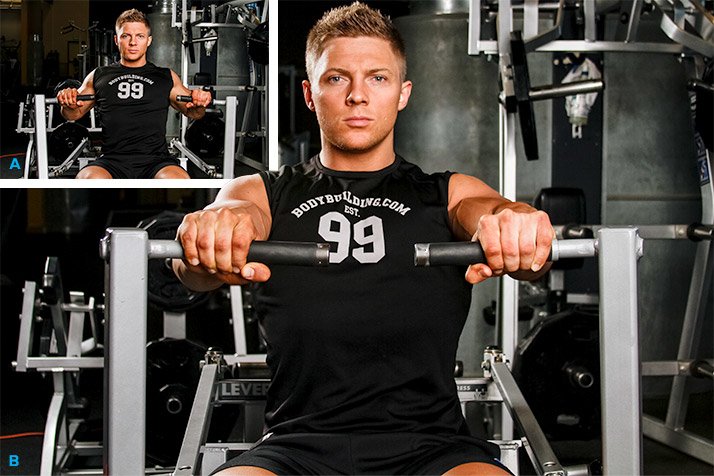
Seated Machine Chest Press
Why it's on the list: Free-weight pressing moves on a flat bench are great, but the machine press has some unique benefits. For one, it's easier to slow down the repetition, both in the concentric and eccentric phases. Stack-loaded machines are also great for quickly doing dropsets.
EMG research demonstrates that the machine bench press recruits much less of the three heads of the deltoid (anterior, middle, and posterior) than free-weight variations because of a decreased need for humeral stabilization.3 This allows you to really target your pecs.

Seated Machine Chest Press
In your workout: Again, do machine exercises at the end of your workout. For anyone looking to build mass, machines give you a greater chance to pump your pecs with minimal shoulder assistance.
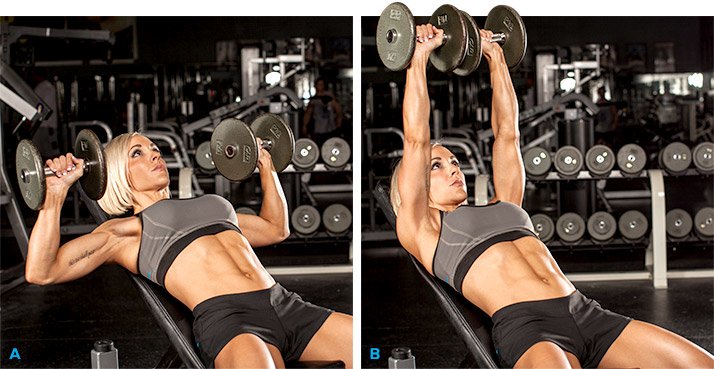
Incline Dumbbell Press
Why it's on the list: Dumbbell presses make everybody's top 10 list, but with an adjustable bench you can do a number of things you can't with a fixed bench. Our favorite: changing the angle of the incline from one set to the next, or from one workout to the next. Hitting a muscle from varying degrees of incline angles builds it more thoroughly.

Incline Dumbbell Press
In your workout: This is an occasional first movement, but it can easily go anywhere from first to third in your routine. Keep in mind, though, that the later you do this movement, the less weight you'll likely be able to push.
For even crazier pumps with this exercise, try to slowly rotate the dumbbells from palms-forward to a palms-inward position during the concentric portion of the lift, really squeezing at the top. This slight change will cause you to medially rotate the upper arm, really recruiting your pec major.
Dip for Chest
Why it's on the list: First off, make sure you're doing dips that emphasize the pecs: Put your feet up behind you, lean forward as far as possible, and allow your elbows to flare out as you dip. Chest dips are a great spotter-free alternative to the decline press.

Dip for Chest
In your workout: If you're strong, this lower-chest move makes a great finisher; if you're not, you can do it earlier in your session. It makes a great superset pairing with push-ups for a big pump at the end of your workout.
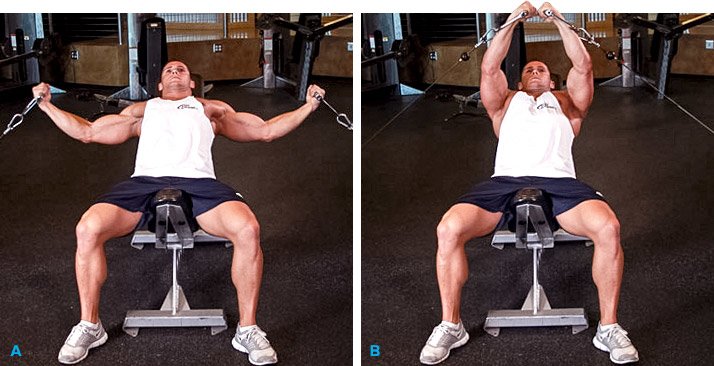
Incline Bench Cable Fly
Why it's on the list: Not many single-joint exercises made the list, but this is one of our favorites. It's an effective move to isolate the pecs after completing your multijoint exercises. Cables allow for continuous tension throughout the exercise's full range of motion. If you've got a good chest pump going, nothing beats looking back at yourself in the mirror as you squeeze out a few more reps.

Incline Bench Cable Fly
In your workout: Do incline cable flyes at the end of your workout for slightly higher reps (sets of 10-12). If you're training with a partner, do a few dropsets for some real masochistic, muscle-building fun!
Incline Dumbbell Pull-Over

Why it's on the list: Forget flat-bench pull-overs; the incline version puts your chest fibers under tension for a longer range of motion! Just sit back against a bench inclined to about 45 degrees and make sure the dumbbell clears the top. Make sure you keep this a single-joint movement; don't bend or extend at the elbows.
Remember, you should have a specific reason for each movement you complete. Pull-over exercises work the shoulder-extension movement pattern (moving the upper arm rearward), which can really torch the pecs since they're one of the primary muscle groups involved in this action!
In your workout: Do pull-overs at the very end of your workout for sets of 12. On every set, hold the peak contraction of the last rep for a full five seconds.
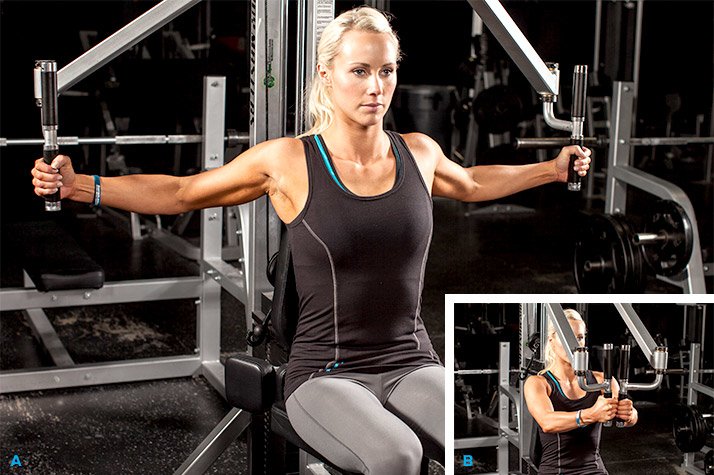
10 Pec-Deck Machine
Why it's on the list: Chest flyes are hard for many trainees to learn with dumbbells or cables because the arms need to be locked in a slightly bent position for the duration of the exercise. Luckily, the pec deck simplifies things because it allows you to work in only one pathway. So, this exercise is a great movement teacher, and you can go for a great pump without having to balance any weights.
EMG data shows that activation of the pectoralis major and anterior delt are statistically similar between the pec deck and bench press, which means that even though you'll probably be working in different rep ranges for each exercise, you'll get great chest activation from this machine.4

Pec-Deck Machine
In your workout: Hit the pec deck last in your chest routine for sets of 10-12. Do dropsets and partial reps, pumping out as many as you can to failure.

The 5 foods to avoid if you want a six pack

The 5 foods to avoid if you want a six pack


Carrying a spare tire around your belly? You're not alone: Fifty-four percent of U.S. adults now have abdominal obesity, up from 46 percent in 2000, according to a recent report in the Journal of the American Medical Association. If you fall into that category (male abs are considered fat if the waistline measures more than 40 inches), it's time to consider cutting down your consumption of these five foods:

1. Refined grains

Not sure what a refined grain is? It's an ingredient found in foods like white rice, white bread, and regular white pasta. The unrefined stuff (whole wheat, brown rice and quinoa) is always healthier. Pennsylvania State University researchers found that people who ate whole grains in addition to keeping a healthy diet—of fruits, vegetables, low-fat dairy and protein—lost more weight from the abdominal area the group of people who kept the same healthy diet but ate all refined grains.

2. Potato products
A study published in the New England Journal of Medicine followed the weight changes of more than 120,000 men and women for up to 20 years. The participants were checked every four years and, on average, they gained 3.35 pounds each time—so almost 17 pounds by the time the study was finished. The foods associated with the greatest weight gain? You guessed it—potato chips and potatoes.

3. Red and processed meat

The same 20-year study found that people who ate more red and processed meat gained weight, too—about one extra pound every four years. In another study, published in the American Journal of Clinical Nutrition, researchers worked with more than 370,000 people and found that folks who ate the equivalent of a small steak a day gained about five pounds in five years.

4. Frosting

Those cupcakes your coworker makes for special occasions? Yeah, don't eat them. While the FDA has basically declared war on trans fats, store-bought frosting still contains a not-so-healthy dose of the stuff. How bad can trans fats be? Researchers at Wake Forest University gave groups of monkeys two different diets; one group ate trans fats and the other ate unsaturated fats.

The results: The group eating trans fats upped their body weight by 7.2 percent in six years and the other only gained 1.8 percent. Not only did the trans fats add new fat, it was also responsible for moving fat from other areas to the belly. Check for trans fat in other foods like pre-made baked goods, snack foods, and frozen pizzas.

5. Diet soda

It's easy to get fooled by the zero-calorie label, yet sodas made with sugar substitutes are believed by many to play a role in weight gain. A new study published this month found that people who drank diet soda gained almost three times the amount of abdominal fat over nine years as those who didn't drink the no-cal stuff.

Sure, that study only looked at adults ages 65 and older, but consider this: Recent research from the Weizmann Institute of Science found that mice drinking water with artificial sweeteners (saccharin, aspartame and sucralose) became vulnerable to insulin resistance and glucose intolerance—two things known to lead to weight gain.

Saturday, July 9, 2016

Being negative and lazy is a disease that leads to pain


Being negative and lazy is a disease that leads to pain, hardship, depression, poor health, and failure. Be proactive and give a damn to achieve success! ----- Phillip Heath

DETAIL RECORD OF MR. OLYMPIA TITLE NOW AND THAN


2016 Mr. Olympia Qualified

NAMECOUNTRY
Bonac, WilliamNetherlands
DeAsha, NathanUnited Kingdom
Elssbiay, MamdouhEgypt
Greene, KaiUSA
Heath, PhilUSA
Jackson, DexterUSA
Kuclo, SteveUSA
Lenartowicz, JoshAustralia
Levrone, KevinUSA
McCarver, DallasUSA
McMillan, CedricUSA
Osladil, LukasCzech Republic
Rhoden, ShawnUSA
Winklaar, RoellyCuracao
Wolf, DennisGermany

Men's Open Point Standings

PLACINGNAMECOUNTRYPOINTS
1Rockel, RonnyGermany16
2Compton, JustinUSA10
3Beyeke, LionelFrance8
3Martinez, VictorDomiican Republic8
3Maxx, CharlesUSA8
3Warren, BranchUSA8
7Jaramillo, RafaelUSA5
7Lockett, MichaelUSA5
7Morel, JuanUSA5
10Fateev, VitalyRussia4
10Jackson, KennethUSA4
10Raymond, JoseUSA4
13Abiad, FouadCanada3
13Curry, BrandonUSA3
13Kefalianos, MichaelGreece3
13Obiad, EssaUAE3
13Piotrkowicz, RobertPoland3
18Bannout, MoeLebanon2
18Centopani, EvanUSA2
18Freeman, ToneyUSA2
18Jackson, JohnnieUSA2
18Lomeli, ManuelMexico2
18Pakulski, BenCanada2
18Rivera, AlexPuerto Rico2
18Smalls, FredUSA2
26Almeida, PauloCanada1
26DeLaRosa, JonathanUSA1
26Dell'uomo, EmilianoItaly1
26Heirati, SasanUnited Kingdom1
26Ray, BrandonUSA1
26Shabunia, AliakseiBelarus1

Mr. Olympia Winners


2015Phil HeathLas Vegas, NV
2014Phil HeathLas Vegas, NV
2013Phil HeathLas Vegas, NV
2012Phil HeathLas Vegas, NV
2011Phil HeathLas Vegas, NV
2010Jay CutlerLas Vegas, NV
2009Jay CutlerLas Vegas, NV
2008Dexter JacksonLas Vegas, NV
2007Jay CutlerLas Vegas, NV
2006Jay Cutler Las Vegas, NV 
2005Ronnie ColemanLas Vegas, NV
2004Ronnie ColemanLas Vegas, NV
2003Ronnie ColemanLas Vegas, NV
2002Ronnie ColemanLas Vegas, NV
2001Ronnie ColemanLas Vegas, NV
2000Ronnie ColemanLas Vegas, NV
1999Ronnie ColemanLas Vegas, NV
1998Ronnie ColemanNew York, NY
1997Dorian YatesLos Angeles, CA
1996Dorian YatesChicago, IL
1995Dorian YatesAtlanta, GA
1994Dorian YatesAtlanta, GA
1993Dorian YatesAtlanta, GA
1992Dorian YatesHelsinki, Finland
1991Lee HaneyOrlando, FL
1990Lee HaneyChicago, IL
1989Lee HaneyRimini, Italy
1988Lee HaneyLos Angeles, CA
1987Lee HaneyGothenburg, Sweden
1986Lee HaneyColumbus, OH
1985Lee HaneyBrussels, Belgium
1984Lee HaneyNew York, NY
1983Samir BannoutMunich, Germany
1982Chris DickersonLondon, England
1981Franco ColumbuColumbus, OH
1980Arnold SchwarzeneggerSydney, Australia
1979Frank ZaneColumbus, OH
1978Frank ZaneColumbus, OH
1977Frank ZaneColumbus, OH
1976Franco ColumbuColumbus, OH
1975Arnold SchwarzeneggerPretoria, South Africa
1974Arnold SchwarzeneggerNew York, NY
1973Arnold SchwarzeneggerNew York, NY
1972Arnold SchwarzeneggerEssen, Germany
1971Arnold SchwarzeneggerParis France
1970Arnold SchwarzeneggerNew York, NY
1969Sergio OlivaNew York, NY
1968Sergio OlivaNew York, NY
1967Sergio OlivaNew York, NY
1966Larry ScottNew York, NY
1965Larry Scott New York, NY

Friday, July 8, 2016

The Ultimate Beginner's Full-Body Workout


The Ultimate Beginner's Full-Body Workout

Beginners, here are the 10 most important training elements you must master, and eight-week full-body beginner's program to start you off on the right foot.
What, you ponder, do you have in common with bodybuilding greats like Arnold Schwarzenegger or Jay Cutler, or even with a successful fitness model like Whitney Reid?
Each of those men, like you, had modest beginnings. None was born with six-pack abs and none came into this world with a 250-pound bench press. But like you, they had a desire for self-improvement and undertook resistance training as a means to build up their physique.
All of these men committed serious mistakes along the way, but fortunately we've compiled a summary of the 10 most important training elements so that you, as a beginner, can learn from others' errors. To get you started off right, we've also put together an eight-week full-body beginner's program that's built to challenge you as you get stronger.
After that break-in period, you'll have one more thing in common with those superstars: None of you will be a rank beginner any longer.

10 KEYS TO BUILDING MUSCLE

There are a lot of guys long on desire, but without the know-how who use the show-up-and-lift-it method, working any and every exercise in the gym every single day and hoping that something happens. Something usually does: They usually quit after about a month because nothing's happened. Fortunately you're on Bodybuilding.com and won't be making those same mistakes. Here's the info you need to understand to get started.
1

WORK THE MAJOR MUSCLE GROUPS

Chances are you started lifting to get a bigger chest and arms, or strengthen your body for a particular sport. But working all the major muscle groups—chest, back, shoulders, quads, glutes, hamstrings, biceps, triceps (smaller muscle groups include the forearms, calves, abs)—allows you to build a symmetrical physique. This complete training also prevents muscular imbalances that can arise when you favor some body parts over others. Imbalances are no joke: They can lead to serious injuries.
2

PRACTICE FORM FIRST

Many of the basic movements presented here may be new to you. As a result, your coordination may be challenged at times. If so, don't worry. Keep practicing and rehearsing the movement pattern and soon it will feel like second nature—and that's when your gains in size and strength will take off. Until then, it's important to understand and practice the basic movements before using more challenging weights.

SEATED DUMBBELL PRESS
3

MULTI-JOINT EXERCISES ARE SUPERIOR OVER SINGLE-JOINT MOVES

Exercises can be categorized into two classes: multi-joint and single-joint. The distinction is that with multi-joint exercises, two (or more) sets of joints work to accomplish the lift. With a single-joint move, only one set of joints is working. During a bench press, for example, action is taking place at both the elbow and shoulder joints, while in a barbell curl the movement is restricted to the elbow joint. Because more muscle is engaged when doing multi-joint moves, you can use far heavier weights and they're therefore better for achieving muscle and strength gains.
4

DO MULTIPLE SETS OF AN EXERCISE

There are decades of scientific research now available on resistance training, and the evidence points to doing 3-4 sets of a given exercise for maximum benefit. Typically you should do a warm-up set or two of that movement before tackling more challenging weights.
5

TOO HEAVY OR TOO LIGHT IS TOO BAD

So how much weight should you lift? Warm-ups are always done with light weight to get the target muscles working in coordination. As a beginner, you'll choose light weights so you can do about 15 reps on each set. The last few reps should be very difficult to achieve but you should always be using "good form."
As you progress, you should use even more challenging weights, ones in which you reach muscle failure by 8-12 reps with good form. If you can do more than that number, the weight is too light. Individuals training for strength choose even heavier weights, typically doing fewer than 6 reps. Remember to never sacrifice form to lift a weight that's too heavy.
6

CONTROL THE REP

The approach you should follow on each and every rep is like this: Inhale and hold your breath as you lift the weight in a strong and forceful manner, exhaling only over the top portion of the movement. Then lower the weight under control as you breathe in. Reverse direction smoothly at the bottom position, never bouncing the weight at the bottom.


7

TAKE A SHORT REST BETWEEN SETS

Your muscles fatigue during a set. They need time to clear the lactic acid and changes in the pH that build up in the surrounding tissue. This usually takes 90-120 seconds, though larger body parts like legs and back may take longer, and smaller muscle groups like arms and calves may take less. A good measure: when you catch your breath and feel ready to go, start a new set.
8

GET AT LEAST 48 HOURS REST BETWEEN WORKOUTS

This is key: The lifting you do at the gym is the stimulus that begins a chain of events that causes the muscle to repair itself and make itself stronger the next time you hit the gym. That takes time, nutrients and rest. Clearly, then, you can't train too often, and dismissing good nutritional habits and shortchanging your rest will be counterproductive to your muscle gains. In terms of training frequency, don't hit a given muscle group more frequently than once every 48 hours. As you become more advanced and add volume, you'll want to increase that rest period.
9

STRIVE TO DO A LITTLE MORE EACH WORKOUT

If your body responds to the training stimulus by growing stronger but you do the same weight for the same reps each workout, it's just not going to grow any further. Hence, you can't fall into the rut of repeating the same workout week-in and week-out. Strive to do more reps with a given weight or increase the weight from one workout to the next—that's the progressive stimulus you need to keep making positive improvements.
10

FOLLOW THIS PLAN FOR 8 WEEKS

As a beginner you'll make noticeable jumps in strength the first two months, but typically gains start to stall when following any given program for too long. That's when it's time to make some larger changes in your training.
After the novice period, you can change your training split by re-arranging muscle groups and the number of exercises, sets, and reps on given days. Manipulating all these variables keeps your training fresh and offers new challenges to overload the target muscles. This is an exciting time for beginners because there are few other times in your training career in which you'll see jumps in strength on your basic lifts from one workout to the next.

AFTER THE NOVICE PERIOD, YOU CAN CHANGE YOUR TRAINING SPLIT BY RE-ARRANGING MUSCLE GROUPS AND THE NUMBER OF EXERCISES, SETS, AND REPS ON GIVEN DAYS.

THE 8-WEEK BEGINNER'S OUTLINE

  • Do one exercise for each of the major muscle groups.
  • The first two weeks you practice your form so the weight should be light. Do additional sets if you want to keep rehearsing the motion.
  • The second two weeks you'll add another set. Start with a light warm-up set, then choose a slightly heavier weight for each of your next two sets. You should approach muscle failure by the target rep listed. Don't sacrifice good form to do more reps if the weight is too heavy. You know you reach muscle failure when you can't do any more reps on a given move with textbook form.
  • You'll start with a light warm-up set during the third phase (weeks 5-8), then choose a more challenging weight for your second and third sets. Try to choose a weight so you can just reach the target rep; if you can do more reps the weight is too light, and if you can't reach the target rep the weight is too heavy.
  • As you get stronger over the course of the program, do more reps and/or increase the weight to progressively challenge the working muscles.
  • If a given barbell or dumbbell exercise is too difficult, find its machine counterpart and practice on that before going back to free weights.
  • Follow this workout three times per week on nonconsecutive days (Mondays, Wednesdays and Fridays).