Showing posts with label Workout tips. Show all posts
Sunday, April 15, 2018
Saturday, November 19, 2016
Phil Heath Workout Routine & Diet Plan
-----------------------------------------------------
Phillip Jerrod Heath or more commonly known as Phil Heath is an American IFBB (International Federation of Bodybuilders) professional bodybuilder who is the winner of Mr. Olympia title 4 times.
“The Gift” (Heath’s nickname) is athletic since childhood. He played basketball during high school. Heath started his bodybuilding career in 2002. But, his career was kick started in 2005 when he was allowed to participate in IFBB pro championship because he won at NPC (National Physique Committee). From that time, he didn’t look back and is performing well in his field. Besides, having double majored in IT and Business Administration and a good basketball player, Phil chose to go in bodybuilding. His decision to go
into bodybuilding turned out be beneficial for him. Now, let us see peek into his workout routine and check out how he made his buffed body.
Phil Heath Workout Routine
---------------------------------------
Heath works with his trainer Hany Rambod, who has devised a special training program called “Fascia Stretch Training” (or FST-7). Heath used this
technique coupled up with other tested and reliable triceps exercises to make his arms reach the 22 inch status. See all of his body measurements.
Regarding his triceps, Phil admits that he didn’t faced any difficulty. In his own words –
“It’s not that I don’t want big triceps, but the truth is, I’ve never had much difficulty adding mass to them.”
FST-7 is so named as an individual is required to perform 7 sets of an exercise with 6-12 reps and 45 seconds rest in between the sets.
One Arm Dumbbell Extensions – 3 sets with 10-12 reps
Two Arm Dumbbell Kickbacks – 3 sets with 10-12 reps
Weighted Dips – 2 sets with 10-12 reps
Cable Push downs – 7 sets with 8-12 reps (A part of FST-7)
During contest season, his bodybuilding workout schedule is rigorous and so he weighs around 110 kg. While during off season, he weighs a little more than that, 125 kg.
Off Season / Pre-Contest Workout Routine
------------------------------------------------------------
He takes care of every body part and his fitness is due to these exercises. Phil does cardio to warm up his body before executing his workout plan, which is divided into 2 training sessions – morning and evening.
Quads, Hamstrings, Calves
--------------------------------------
In the morning session, to get quads, hamstrings and calves muscles, he does these exercises –
Extensions – 4 sets with 8-12 reps
Front Squats – 4 sets with 6-8 reps
Leg Presses – 3 sets with 6-8 reps
Hack Squats – 7 sets with 6-8 reps
Standing Calf Raises – 4 sets with 15-20 reps
Leg Press Calf Raises – 4 sets with 15-20 reps
Seated Calf Raises – 7 sets with 12-15 reps
Hamstring
He also focus more on his hamstring muscles found at the back of the thighs after 6 pm.
Stiff-Leg Dead lifts – 4 sets with 6-8 reps
Lying Leg Curls – 4 sets with 6-8 reps
Seated Leg Curls (Dagger) – 7 sets with 5-7 reps
Chest & Triceps
Now, comes the chest and triceps –
Dumbbell Incline Presses – 4 sets with 6-8 reps
Dumbbell Incline Flyes – 4 sets with 6-8 reps
Hammer Strength Bench Presses – 3 sets with 6-8 reps
Pec Decks – 7 sets with 6-8 reps
Triceps
Push downs with Rope Attachment – 3 sets with 12 reps
Dips – 3 sets with 12 reps
Close-Grip Bench Presses – 3 sets with 6-8 reps
Lying Triceps Extensions – 7 sets with 6-8 reps
Back and Biceps
Wide-Grip Pull-Ups – 3 sets with 10 reps
Power-Grip Chin-Ups – 3 sets with 10 reps
T-Bar Rows – 4 sets with 6-8 reps
Bent-Over Rows (Underhand Grip) – 4 sets with 6-8 reps
One-Arm Dumbbell Rows – 3 sets with 6-8 reps
Straight-Arm Pull Downs with Rope Attachment – 7 sets with 12 reps
Biceps
Standing EZ-Bar Curls – 3 sets with 6-8 reps
Hammer Curls – 3 sets 6-8 with reps
Concentration Curls – 3 sets with 6-8 reps
Dumbbell Preacher Curls – 7 sets with 5-7 reps
Shoulders and Traps
Dumbbell Military Presses – 4 sets with 6-8 reps
Dumbbell Front Raises – 4 sets with 6-8 reps
Upright Rows – 4 sets 6-8 with reps
Dumbbell Lateral Raises – 7 sets with 6-8 reps
Traps
Dumbbell Shrugs – 4 sets with 6-8 reps
Barbell Shrugs – 4 sets with 6-8 reps
Rear Delts
Bent-Over Dumbbell Raises – 4 sets with 6-8 reps
Reverse Pec Decks – 7 sets with 6-8 reps
“The Gift” suggests to not to invent any new exercises if what you are currently doing is working for you. Sometimes he does not count the sets for the exercise which he is doing at that time because he do not want to over work on his muscles and keeps the energy free for the evening sessions or the cardio workout. So, it is not a hard and fast rule that he sticks to the about routine. Heath amends it based upon his needs and the future contests.
Another tip from the famous bodybuilder is that you may not want to hammer your body in the gym to gain muscles and chiseled body, if your body is not recovering or not responding to the workout as it should be.
So, do workout intelligently, which is the key to success. Most people fail to figure out which workout will work best for them.
Phil Heath Diet Plan
----------------------------
This bodybuilder’s diet is divided into various shifts, that means, he eats frequently during the whole day.
Off Season
----------------
Meal 1
12 oz. chicken
1 cup of egg whites
1 cup of cream of rice
Anabolic VITAKIC™ 1 serving
Meal 2
12 oz.(336g) 94% ground beef
2 cups of white rice
Meal 3
12 oz. beef tenderloin
8 oz.(224g) whole wheat pasta
Training Time
-------------------
Pre-Workout
naNO Vapor Hardcore Pro Series
naNOX9™ Hardcore 1 serving
Post-Workout
--------------------
Cell-Tech™ Hardcore Pro Series
Nitro Isolate 65™ Pro Series
Meal 4
6-8 oz. beef tenderloin
10 oz. white potato
Meal 5
12 oz. chicken
1 cup of spinach
Meal 6
12 oz. of 94% ground beef
1 cup of broccoli
Meal 7
2 tbsp. of almond butter
Nitro Isolate 65™ Pro Series
Pre-Contest Diet
------------------------
Meal 1
2.5 cups egg whites
1 cup of oatmeal
Meal 2
12 oz. white chicken breast
1 cup of brown rice
Steamed vegetables
Meal 3
12 oz. beef tenderloin
Medium sweet potato
Training Time
Pre-Workout
------------------
naNO Vapor Hardcore Pro Series
naNOX9™ 1 serving
Post-Workout
--------------------
Cell-Tech™ Hardcore Pro Series
Nitro Isolate 65™ Pro Series
Meal 4
12 oz. beef tenderloin
Medium sweet potato
Meal 5
12 oz. white chicken breast
1 cup brown rice
Meal 6 & 7
12 oz. halibut or tilapia
Steamed broccoli
Monday, September 26, 2016
5 Chest Workout For Muscle And Definition छातीको मांसपेसीमा निखार ल्याउनका निम्ति ५ उपयुक्त व्यायाम
5 5 Chest Workout For Muscle And Definition
छातीको मांसपेसीमा निखार ल्याउनका निम्ति ५ उपयुक्त व्यायाम
Thursday, September 15, 2016
Wednesday, July 13, 2016
8 Pack Abs Workout: How To Get The Ultimate 8 Pack
Forget the highly coveted six pack. Bodybuilder Brad Borland presents three intense abdominal workouts that will help you build a thick 8 pack.
WORKOUT SUMMARY
Main Goal General FitnessWorkout Type SplitTraining Level BeginnerDays Per Week 1Equipment Required Bodyweight, OtherTarget Gender Male & Female Author Brad Borland
WORKOUT DESCRIPTION
Let’s face it; having to read about another abs workout program is like trying to get excited about going to the dentist. Both sometimes seem to be more of a chore than finding anything remotely fun. And to make matters even worse, performing and maintaining a genuine abs routine is like buying new tires; not something you really like to spend your time or money on but you know deep down they will improve performance.
A necessary evil? Yes, but let’s change that!
Sure, diet is paramount when it comes to developing great abs for all to see, but you mustn’t forgo a solid and effective ab program to reap the maximum benefits from your efforts. It’s time to stop throwing in a few sets of crunches at the end of a workout with empty hopes that one day your eight pack will suddenly reveal itself through pitiful focus.
Stop kidding yourself. Draw a line in the sand and stop wasting time and energy spinning your wheels and adhere to a sound and effective plan of attack to boost gains for not only vanity reasons but also increase performance residually through other lifts. A solid core can be a key factor regarding strength providing improved balance and shoring up weak midsection stability during big lifts.
In short, a stronger core equals stronger squats, deadlifts and bench presses. Everything (power, strength, stability) is first derived from our core. If this area gets its due attention we have no choice but to reap reward in its execution. A tight, strong midsection creates whole-body strength and who would pass that up?
What makes up the abs?
The muscles of the abdominals comprise of several areas that flex, extend, twist and stabilize the trunk area. They sit on the front sides of the lower torso originating along the ribcage and attaching along the pelvis. Below is a quick look at each muscle and its function.
Rectus Abdominus: This is the coveted “six-pack” muscle – although it has more than six heads. This muscle flexes the spine and brings the ribcage and pelvis closer together.
Transverse Abdominus: This muscle is a deep muscle of the core which lies beneath the other muscles that is essential for trunk stability.
Internal and External Obliques: These are diagonal muscles that work to rotate the torso and stabilize the abdomen.
Your 10 exercise abdominal arsenal
Below are ten key moves and their modifications to help you crunch, squeeze and pound your abs into tempered steel.
Leg raises
Leg raises can be performed on a flat bench, a decline bench or hanging. For the hanging version, begin with a straight leg and then as you tire, bend your knees to keep the set going for an intense burn. While hanging from a chinning bar raise up your legs as in the lying raises and stop when your legs are at parallel with the floor and return. For knee raises bring your knees into you abdominal region until they are past parallel and squeeze. Lower just short of perpendicular with the floor to keep tension on the region.
Bicycles
You can perform bicycles the traditional way by alternating sides or make it a bit more challenging by isolating one side and then switching over to the other. Just perform all reps for one side then switch and do the allotted number of reps for the other.
Planks
Once you reach a level of several sets of 30 seconds with the traditional plank it is time for a new challenge. Have a partner place a weight plate (one that is at first light enough to handle) on your upper back to add resistance. Just be sure to keep your entire body tight and don’t let the weight “bow” your body.
Dragon flags
For the more advanced out there, try performing the dragon flag on a decline bench. This will take incredible strength and balance, but you will reap incredible benefits of more strength and stability once mastered.
Windshield wipers
Once you have the basic windshield wiper movement down it is time to up the intensity. Perform the movement as you would normally, but now place a small weighted medicine ball between your feet. It is a tough addition and requires serious strength and technique.
Side planks
For more of a challenge, try switching from a side plank to a normal plank over to another side plank slowly. Be sure to keep the body aligned and perform the movement in a steady, deliberate motion sustaining good form and function.
Russian twists
If you find using a medicine ball or weight plate difficult with this movement simply clasp your hands in front of you and perform the exercise as usual. This will build up your strength quickly so you may graduate up to using weight in the near future.
Crunches
The many forms of the crunch include performing them on a flex-ball, feet supported on a bench, and weighted by holding a small weight plate on your chest. You can also try weighted crunches by lying on the floor with your head toward a rope attachment on a low pulley and pull the weight up while you crunch. Be sure to hold the ends of the rope on either side of your head when performing this move.
Side crunches
In addition to performing traditional side crunches on a sit-up bench or on the floor, side crunches can also be performed on a Roman chair. Position yourself with your feet and hip contacting the bench while your upper body is suspended. Crunch your pelvis by twisting and bending your knees side-to-side.
Sit-ups
Sit-ups can be modified using a decline bench and holding a weight plate on your chest with crossed arms. This addition can be a bit of a challenge, so try it with a weight you can handle first.
Try one, two or all of the routines below for a complete ab workout in very little time. You can try one workout three times per week or use all three over a week. Be sure to rest no more than 20 seconds between exercises and after supersets. Always perform proper technique while performing each move deliberately and under control.
3 Ab Workouts For The Ultimate 8 Pack
Routine #1
Ab Workout
Exercise Sets Reps
Crunches on a Flex Ball 3 15
Hanging Leg Raises 3 15
Bicycles 3 20
Routine #2
Ab Workout
Exercise Sets Reps
Side Crunches on Roman Chair 3 15
Low Pulley Crunches 3 15
Windshield Wipers 3 20
3 Way Plank 3 20-30 Seconds
Routine #3
Ab Workout
Exercise Sets Reps
Dragon Flag 3 As many as possible
Superset: Straight Leg Raises and Bent Leg Raises 3 10
Superset: Russian Twists (3 x 10 each side) with Floor Crunch (3x15)
18 Week Chin Up & Dip Program For An Impressive Upper Body
Chin ups and dips are 2 overlooked but important bodyweight exercises. This 18 week workout protocol features a single training day dedicated to these movements.
WORKOUT SUMMARY
Main Goal : Build Muscle
Workout Type : Single Muscle Group
Training Level : Beginner
Days Per Week : 4
Equipment Required : Bodyweight, Other
Target Gender : Male & Female
Author : Raazu Thapa
WORKOUT DESCRIPTION
What would you say if I told you that two moves could drastically change the way your upper body looks and feels? What if I told you that those two moves have been around since the dawn of training and offer excellent results?
You would probably think it sounds like the standard fitness sales pitch. But, what I am about to tell you is definitely 100% true. Chin ups and dips are the keys to building a complete upper body.
Prioritizing Chins and Dips
In today’s get fit quick society, no one wants to put in the hard effort to become what they desire to become. Many males desire to have a full and ripped upper body. The problem is that many males want to take shortcuts to try to achieve that goal.
Lame workout design, too much volume, and avoiding progressive overload are the three biggest causes for concern. The typical meathead routine of flat bench, incline bench, decline bench, horizontal machine press, dumbbell fly, and cable crossover all in the same day with a ridiculous amount of volume is not the answer for the complete upper body.
When you add in way too many drop sets and forced reps into oblivion, you have the recipe for total disaster. I know many folks who perform this routine weekly and have nothing but a wide, unsculpted chest to show for it. It is absolutely appalling.
I love to study other disciplines in the world of athletics. Every sport has a bodypart that stands out due to the training used in that field. Sprinters have the greatest hamstrings and glutes on the planet. Speed skaters and sprint cyclists have quads that put some bodybuilders to shame. And male gymnasts have supreme, superhero like upper bodies! And from what I know these guys are doing a lot of upper body pushing and pulling namely a great, great amount of chinning and dipping variations.
In my opinion chins and dips are the ultimate moves for the upper body. Chins and dips have always been a staple of my training but normally as part of a training session. The new thought in my brain early last year was what if I dedicated a separate day to only chins and dips? The mere thought of this had me fired up like Ray Lewis during the pre game.
The results were astounding. I programmed the chins and dips into my training as a separate day and before I knew it, I had developed a thicker and fuller upper body.
Hitting chins and dips with heavy weight offset with high volume forced me to grow. A thicker chest, a much wider back, and larger arms were all a result to this programming change. The frequency of doing them as a separate day combined with my training protocols plus the progressive overload had my upper body growing like Rocky’s beard in Russia.
I also noticed that as my chins and dips became stronger, my other pressing and pulling moves were getting stronger too. But enough about me because now it is time for you to grow.
Below I will outline a basic 18 week chin and dip protocol to get you going in the right direction. And please remember this very important fact. A lot of phony fads in the game today promise you some unbelievable results in a very limited block of time. 4 week abs, 60 days to a massive chest or similar gimmicks. I am not about that and I do not stand for it.
Real results take time and effort. What I will promise you is this though. If you follow this chins and dips and protocol, you will be stronger and more muscular in your upper body at the end of 18 weeks. I do not know how dramatic the results will be because everyone responds differently and everyone’s nutrition will be different. But you will be better, believe that.
Overview
You will perform your chins and dips as a separate day each week for 18 weeks. On that day you will only perform chins and dips. The scheme will be a basic Legs-Push-Pull split. Your training week will look like this:
Monday - Chins and Dips
Tuesday - Legs
Wednesday - Off
Thursday - Push
Friday - Pull
Saturday - Sprints or Off
Sunday - Off
The Training Scheme
You will need to purchase a dip belt so make that a priority and get one. Remember, progressive overload is a very important key to making great gains. We are not doing all the difficult movements that gymnasts perform daily so our challenge has to be adding more weight or working faster.
Once you can complete the whole day without a missed rep, it is time to move up in weight. Doing bodyweight dips for 5×10 for three weeks makes you Anderson Average. You do not want to be the run of the mill stagnant lifter.
For the first three weeks you will use a basic 5×5 training scheme for your chins and dips. Remember with 5×5 you have two options. You can increase the weight slightly each set, or use the same weight for each round even if it starts off as bodyweight.
For the second three weeks you will use more volume and use a basic 5×10 scheme. Again you can increase the weight slightly each set, or use the same weight for each round even if it is bodyweight. You will also be performing the moves as a superset but with a slightly longer rest than a typical superset.
For the 5×5, after you start with your chins, you will rest 1 minute before performing the dips and then rest 2 minutes before starting the rounds over again. For the 5×10 you will rest 45 seconds before performing the dips and then rest 90 seconds before starting the rounds over again.
The third scheme of the phase will be performing the chins and dips RP-21 style with the 7×3 and 6×5 schemes. Please refer to my article on RP-21 for a detailed explanation of RP-21.
Week 1-3 - 5×5 Chins and Dips, rest 1 minute between moves and 2 minutes between sets
Week 4-6 - 5×10 Chins and Dips, rest 30-45 seconds between moves and 60-90 seconds between sets
Week 7-9 - RP-21 Chins and Dips, use the 7×3 and the 6×5 scheme on the same day. Perform the Chins 7×3, rest 2-3 minutes and then perform the Dips 7×3. After the dips rest 2-3 more minutes before performing the 6×5 chins. Rest 2-3 minutes and then perform the 6×5 dips. Please refer to my RP-21 training scheme for the details of the 7×3 and 6×5 sets.
Week 10-12 - Repeat week 1-3, but with heavier loads
Week 13-15 - Repeat week 4-6, but with heavier loads
Week 16-18 - Repeat week 7-9, but with heavier loads
Conclusion
Simplicity is the key to life. When things are made supremely complex, the natural human nature is to lose focus and eventually quit. With this simple scheme here you can begin to improve your upper body.
Chins and dips are basic movements that are thee go-to movements for the upper body. All you need to do is simply record your weights/reps and move forward.
Eat accordingly to your goal whether it is to lose fat or gain muscle mass. And if you train hard enough, you too may develop that superhero upper body. But also make sure you definitely have the solid wheels to match the upper body.
People fear and respect a character like Batman. He has a balanced and imposing superhero physique. People laugh at a character like Johnny Bravo. His legs were used as pipe cleaners for my kitchen pipes last week. Keep it simple and make progress!
Head-To-Toe Training In Under An Hour
When you're looking for a great workout that's high in intensity but short on time, nothing beats total-body training. By using everything in your (gym) bag of tricks—compound movements, plyometrics, supersets, giant sets, and functional training—you can hit every muscle group, get your heart pumping, and obliterate mega calories. The best part? You'll be in and out of the gym in under an hour. Integrate these routines from top NLA for Her athletes into your workout to get in peak condition this summer.
1 SUPER-DUPER SETS
To boost intensity while amping her calorie burn, IFBB pro Caryn Paolini uses several advanced training techniques within a single total-body workout. By reducing rest intervals with supersets and trisets, she's able to keep her workouts fast-paced and her training intense. After a brisk, dynamic stretch, Paolini kicks off her workout with 5 sets of 15 reps for both stationary lunges and dive-bomber push-ups. The stationary lunges target her quads and hit her glutes, calves, and hamstrings. Dive-bomber push-ups target her entire body while dynamically building both strength and flexibility in her chest, shoulders, and triceps.After getting limber, Paolini gets into the meat of the program, kicking things off with a superset that hits both her upper and lower body and keeps her heart rate elevated for the entirety of the workout.
Paolini also loves to include plyometrics in her once-a-week total-body programming to improve endurance, save time, and burn calories. "Plyometrics are a great alternative to cardio—something to do rather than jumping on a boring machine," she says.
SUPER-DUPER SET WORKOUT
WARM-UP 1
DYNAMIC STRETCHING
BODYWEIGHT REVERSE LUNGE
5 sets of 15 reps per leg
DIVE-BOMBER PUSH-UP
5 sets of 10-15 reps
SUPERSET 2
DUMBBELL THRUSTER (SHOWN W/ KETTLEBELLS)
4 sets of 15 reps
JUMP SQUAT
4 sets of 20 reps, rest 60 sec.
TRISET 3
CABLE ROPE PRESS-DOWN
4 sets of 15 reps
CABLE ROPE BICEPS CURL
4 sets of 15 reps
BURPEE
20 reps, rest 60 sec.
SUPERSET 4
BARBELL STEP-UP
4 sets of 15 reps
JUMP LUNGE
4 sets of 15 reps, rest 60 sec.
TRISET 5
WIDE-GRIP LAT PULL-DOWN
4 sets of 15 reps
CABLE LOW ROW
4 sets of 15 reps
BENCH DIP
4 sets of 20-25 reps
SUPERSET 6
KETTLEBELL SUMO SQUAT TO ROW
4 sets of 15 reps
LATERAL BAND WALK
4 sets of 20 steps per side
FINISHER 7
WALKING LUNGE
1 set, length of gym and back
SIDE WALKING LUNGE
1 set, length of gym and back
FROG JUMP
1 set, length of gym and back
COOL-DOWN 8
STRETCHING
FOAM ROLLING
2 PUMPED-UP CIRCUITS
Circuits are a popular total-body workout strategy because they increase the intensity of a workout through continual movement and shortened rest periods. NPC bikini competitor Theresa Miller loves putting her own twist on traditional circuit training. "Instead of doing one set of each exercise for four rounds, I do two sets of each for two rounds," says Miller. Her reasoning is twofold: Her muscles get a little more fatigued with two sets than they would with a single one—offering greater opportunity for change and adaptation—and each muscle group also gets a little more rest between sets, making it easier to go harder in the second round.
The extra energy is much needed. While Round 1 uses moderately challenging weight, Round 2 adds an extra challenge, boosts intensity, and makes the most of the short workout circuit by calling for heavier weights.
PUMPED-UP CIRCUIT WORKOUT
WARM-UP 1
STAIRMASTER
10 minutes
CIRCUIT 2
BACK SQUAT
2 sets of 12-15 reps, rest 30 sec.
BARBELL WALKING LUNGE
2 sets of 12 reps, rest 30 sec.
JUMP SQUAT
2 sets of 12-15 reps, rest 30 sec.
PULL-UP
2 sets of 12 reps, rest 30 sec.
BARBELL SHOULDER PRESS
2 sets of 15 reps, rest 30 sec.
BURPEE
2 sets of 15 reps, rest 20-30 sec.
PUSH-UP
2 sets of 12-15 reps, rest 30 sec.
HIGH KNEE
2 sets of 20-30 seconds, rest 30 sec.
BICYCLE CRUNCH
2 sets of 25 reps, rest 30 sec.
PLANK
2 sets of 30-60 sec., rest 30 sec.
Note: Perform 2 sets of each movement, then circle back to the beginning and do another two sets of each move. That's 4 sets total.
COOL-DOWN 3
STAIRMASTER
20 minutes
STRETCHING
3 STRENGTH TRAINING AND HIIT COMBO
Even if you're a devout body-part traditionalist like fitness model Lais De Leon, you can still benefit from the occasional total-body workout. "Instead of only targeting a body part once a week, you have the opportunity to hit it twice," DeLeon says. "This potentially provides faster results."
Though she normally prefers straight-set training for hypertrophy purposes, DeLeon incorporates supersets on total-body days to save time. However, she always follows one rule: Keep cardio separate. "I never blend cardio into my total-body workout," she says. "It expends too much energy and results in less productive lifts." Saving time at the end for a solid HIIT session allows her to prioritize strength training and keep the focus on hypertrophy while still getting in a quality sweat session.
When gearing up for a hard workout, even a short one, it's important to fuel smart—before, after, and during a workout. "I always have Her Aminos intra-workout to preserve as much muscle as possible," DeLeon says. "Post-workout, I have a protein shake to promote protein synthesis."
STRENGTH TRAINING AND HIIT COMBO
WARM-UP 1
DYNAMIC STRETCHING
STAIRMASTER
10 minutes
SUPERSET 2
BARBELL SQUAT
4 sets of 12-15 reps
STIFF-LEGGED BARBELL DEADLIFT
4 sets of 10-12 reps, rest 1 min.
SUPERSET 3
DUMBBELL BENCH PRESS
4 sets of 10 reps
DUMBBELL FRONT RAISE TO LATERAL RAISE
4 sets of 15-20 reps, rest 1 min.
SUPERSET 4
EZ-BAR CURL
4 sets of 21 reps using 21 method*
CABLE ROPE PRESS-DOWN
4 sets of 20 reps, rest 1 min.
Note: Perform 7 partial reps in the bottom half range of motion, 7 in the top half, and 7 full reps without stopping.
CIRCUIT: 4 ROUNDS 5
PULL-UP
to failure
ASSISTED PULL-UP
8-10 reps
TOES-TO-BAR
to failure
HANGING KNEE RAISE
10-20 reps
HIIT MODALITY OF CHOICE
15-20 min., alternating 1 min. high speed, 1-min. active rest
COOL-DOWN 6
STRETCHING
FOAM ROLLING
4 ALL-IN-ONE CIRCUIT
IFBB figure pro Jessie Hilgenberg is known for her rigorous training routine, but sometimes even the most dedicated athletes need programming flexibility. "If I'm traveling, low on time, or know I won't be able to get in all my workouts that week, I opt for a total-body workout," Hilgenberg says.
After a solid warm-up, she begins her circuit by doing one set of 12 reps or following a set time for each exercise. The key is the limited rest she takes between sets. Keeping the turnover between exercises to under a minute keeps the intensity high. The quick transition also increases stimulation and, more importantly, prevents boredom. "Circuits like this allow me to push quickly and keep my muscles guessing," she says.
If she's really short on time, Hilgenberg cuts a few negative pull-ups from her program and doubles or triples the exercises into supersets and giant sets to get 'er done. At the end of each round, she throws in a cardio element to burn off a few more calories and finish strong. "I use jumping lunges or jump rope to get my heart rate up again," Hilgenberg says. "It also saves time, since I get my cardio and my lifting done at once."
ALL-IN-ONE CIRCUIT
WARM-UP 1
TREADMILL OR STAIR-CLIMBER
10 min.
CIRCUIT 2
PLANK
45-60 sec.
PULL-UP
10-12 reps
SUMO SQUAT, FEET ELEVATED ON STEP
12 reps
INCLINE DUMBBELL PRESS
12 reps
REVERSE LUNGE TO CABLE ROW
12 reps per leg
BARBELL CURL
12 reps
LATERAL DUMBBELL RAISE
12 reps
TRICEPS PUSH-DOWN
12 reps
ROPE JUMPING
Tuesday, July 12, 2016
10 Best Chest Exercises For Building Muscle
There are dozens of exercises you can do on chest day. In fact, the Bodybuilding.com Exercise Database lists at least 84, but you probably don't want to spend a Monday afternoon—or several Mondays—trying them all. You just want to know the best exercises for building a muscular chest, no questions asked. We've done the work for you, and found the top 10.
Mind you, this list doesn't correlate to the hardest chest exercises. It's focused on the best-of-the-best mass builders, with a little bit of instruction and explanation to complement each choice. You can swap exercises in your current routine for these choices, build your own chest workout with a handful of them, or just try one when your standard chest workout gets stale.
Without further ado, here are our top 10 chest-building exercises, ranked in no particular order.
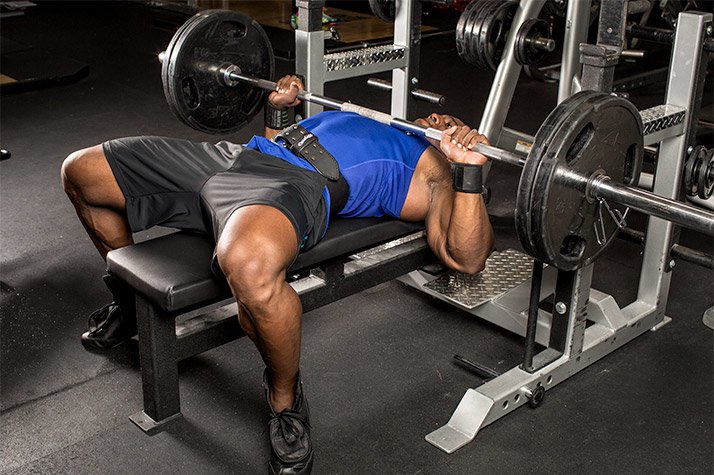
1 Barbell Bench Press
Why it's on the list: You can generate the most power with barbell lifts, so the standard barbell bench allows you to move the most weight. It's also an easier lift to control than pressing with heavy dumbbells. The exercise is easy to spot and relatively easy to learn (if not master), There are plenty of bench-press programs you can follow to increase your strength.

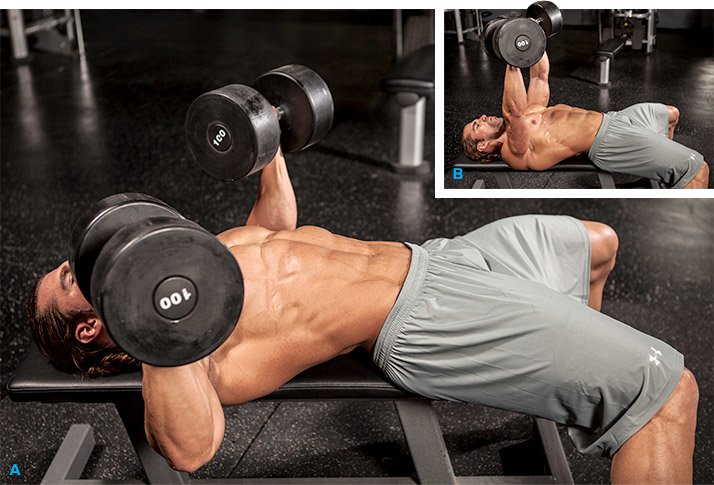
Why it's on the list: With dumbbells, each side of your body must work independently, which recruits more stabilizer muscles; dumbbells are harder to control than a barbell. Dumbbells also allow for a longer range of motion than the barbell bench press, both at the bottom and top of the movement. Flat dumbbell presses allow you to hoist a fairly heavy weight, and they make for a good alternative if you've been stuck on the barbell bench for ages.

In fact, the similar nature of these movements was confirmed via electromyography (EMG) analysis, which demonstrated no significant differences between flat-bench dumbbell and barbell in regard to muscle activation.
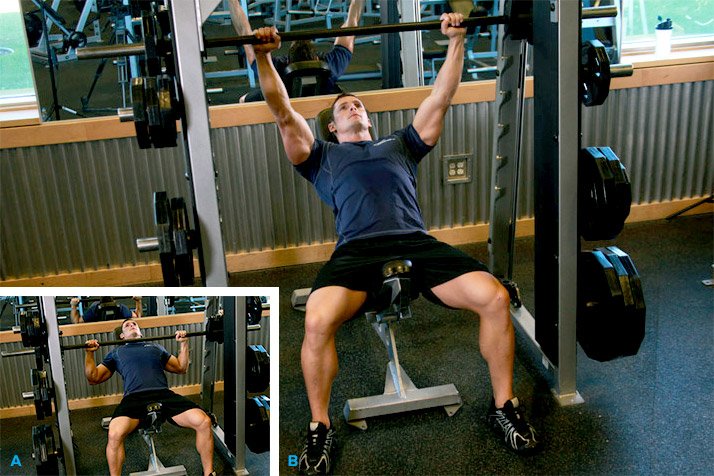
3 Low-Incline Barbell Bench Press
Why it's on the list: Many benches are fixed at a very steep angle, which requires a larger contribution from the front delts than the chest to move the weight.2 If possible, go for a less-steep incline to hit the upper pecs without as much stress on the delts. You can also easily do low-incline benches with an adjustable bench on the Smith machine.
If you're really looking to build that shelf of an upper chest, EMG results have suggested that bringing your grip in a bit closer may hammer upper-chest fibers significantly more.2

4 Machine Decline Press (Cross-Body)
Why it's on the list: Some machines, like Hammer Strength, allow you to move each arm independently, which is a great feature on chest day. Besides doing a machine decline press straight on, you can sit sideways on the apparatus and press across your body one arm at a time, which delivers a completely different feel than when you sit straight-on.
One of the primary muscle actions of the pec major is transverse adduction—think cable flyes or pec-deck flyes to understand this action. By sitting in a sideways position, you can maximize your press with a pec-dominant horizontal adduction, effectively getting more from the movement.
In your workout: Do free-weight exercises first in your chest workout because they require more effort and stabilizer muscles than machines. With that in mind, this could be the last multijoint exercise in your routine.
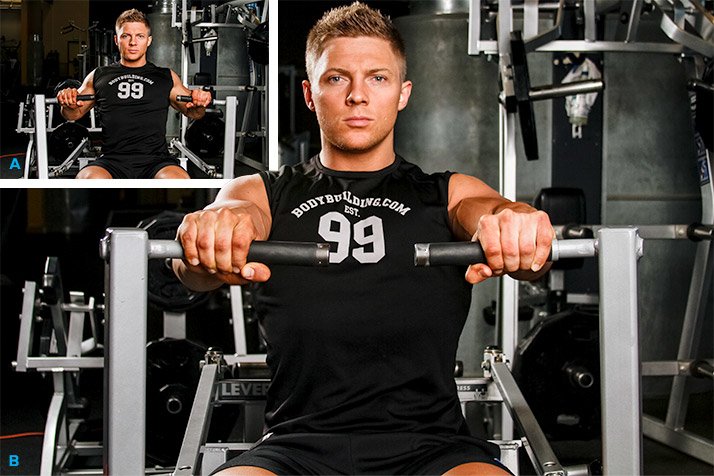
5 Seated Machine Chest Press
Why it's on the list: Free-weight pressing moves on a flat bench are great, but the machine press has some unique benefits. For one, it's easier to slow down the repetition, both in the concentric and eccentric phases. Stack-loaded machines are also great for quickly doing dropsets.
EMG research demonstrates that the machine bench press recruits much less of the three heads of the deltoid (anterior, middle, and posterior) than free-weight variations because of a decreased need for humeral stabilization.3 This allows you to really target your pecs.

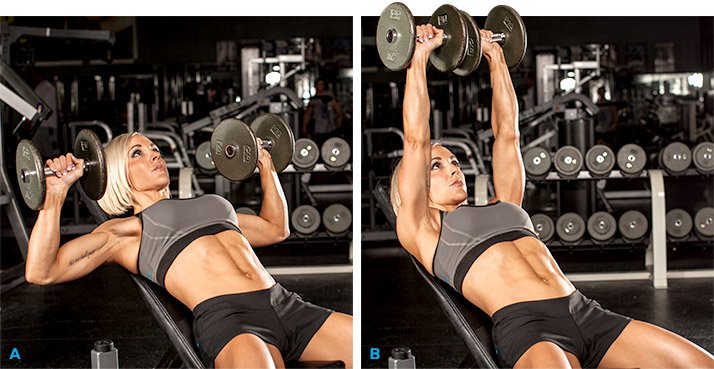
6 Incline Dumbbell Press
Why it's on the list: Dumbbell presses make everybody's top 10 list, but with an adjustable bench you can do a number of things you can't with a fixed bench. Our favorite: changing the angle of the incline from one set to the next, or from one workout to the next. Hitting a muscle from varying degrees of incline angles builds it more thoroughly.

For even crazier pumps with this exercise, try to slowly rotate the dumbbells from palms-forward to a palms-inward position during the concentric portion of the lift, really squeezing at the top. This slight change will cause you to medially rotate the upper arm, really recruiting your pec major.
7 Dip for Chest
Why it's on the list: First off, make sure you're doing dips that emphasize the pecs: Put your feet up behind you, lean forward as far as possible, and allow your elbows to flare out as you dip. Chest dips are a great spotter-free alternative to the decline press.

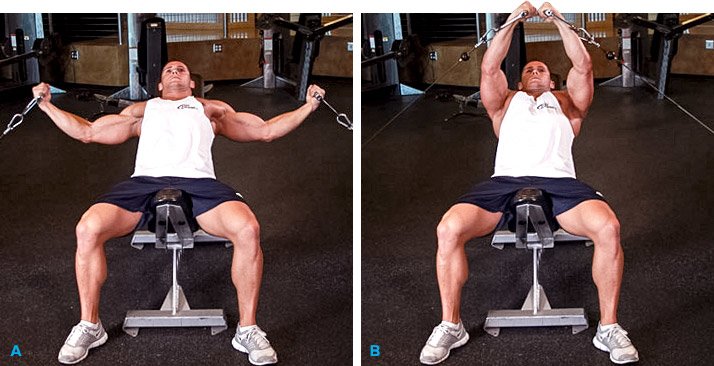
8 Incline Bench Cable Fly
Why it's on the list: Not many single-joint exercises made the list, but this is one of our favorites. It's an effective move to isolate the pecs after completing your multijoint exercises. Cables allow for continuous tension throughout the exercise's full range of motion. If you've got a good chest pump going, nothing beats looking back at yourself in the mirror as you squeeze out a few more reps.

9 Incline Dumbbell Pull-Over
Why it's on the list: Forget flat-bench pull-overs; the incline version puts your chest fibers under tension for a longer range of motion! Just sit back against a bench inclined to about 45 degrees and make sure the dumbbell clears the top. Make sure you keep this a single-joint movement; don't bend or extend at the elbows.
Remember, you should have a specific reason for each movement you complete. Pull-over exercises work the shoulder-extension movement pattern (moving the upper arm rearward), which can really torch the pecs since they're one of the primary muscle groups involved in this action!
In your workout: Do pull-overs at the very end of your workout for sets of 12. On every set, hold the peak contraction of the last rep for a full five seconds.
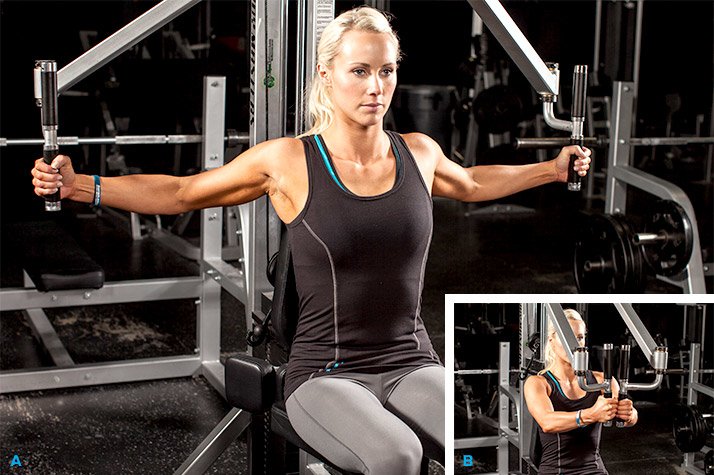
10 Pec-Deck Machine
Why it's on the list: Chest flyes are hard for many trainees to learn with dumbbells or cables because the arms need to be locked in a slightly bent position for the duration of the exercise. Luckily, the pec deck simplifies things because it allows you to work in only one pathway. So, this exercise is a great movement teacher, and you can go for a great pump without having to balance any weights.
EMG data shows that activation of the pectoralis major and anterior delt are statistically similar between the pec deck and bench press, which means that even though you'll probably be working in different rep ranges for each exercise, you'll get great chest activation from this machine.4

Without further ado, here are our top 10 chest-building exercises, ranked in no particular order.
1 Barbell Bench Press
Why it's on the list: You can generate the most power with barbell lifts, so the standard barbell bench allows you to move the most weight. It's also an easier lift to control than pressing with heavy dumbbells. The exercise is easy to spot and relatively easy to learn (if not master), There are plenty of bench-press programs you can follow to increase your strength.

Barbell Bench Press
In your workout: Do it toward the start of your chest workout for heavy sets in lower rep ranges. Consider varying your grip width for more complete chest development.
2 Flat-Bench Dumbbell PressWhy it's on the list: With dumbbells, each side of your body must work independently, which recruits more stabilizer muscles; dumbbells are harder to control than a barbell. Dumbbells also allow for a longer range of motion than the barbell bench press, both at the bottom and top of the movement. Flat dumbbell presses allow you to hoist a fairly heavy weight, and they make for a good alternative if you've been stuck on the barbell bench for ages.

Flat-Bench Dumbbell Press
In your workout: Do flat dumbbell presses toward the start of your chest workout for heavy sets in lower rep ranges. We don't typically recommend doing dumbbell presses in addition to the barbell bench press, because both moves are so similar.In fact, the similar nature of these movements was confirmed via electromyography (EMG) analysis, which demonstrated no significant differences between flat-bench dumbbell and barbell in regard to muscle activation.
3 Low-Incline Barbell Bench Press
Why it's on the list: Many benches are fixed at a very steep angle, which requires a larger contribution from the front delts than the chest to move the weight.2 If possible, go for a less-steep incline to hit the upper pecs without as much stress on the delts. You can also easily do low-incline benches with an adjustable bench on the Smith machine.
If you're really looking to build that shelf of an upper chest, EMG results have suggested that bringing your grip in a bit closer may hammer upper-chest fibers significantly more.2

Low-Incline Barbell Bench Press
In your workout: Many chest workouts start with flat-bench movements first, then progress to inclines, but it's time to get out of that bad habit. Every so often, start with inclines. The benefit is that you'll be fresher and can lift more weight, which puts a greater amount of stress on the upper pec fibers and could lead to more growth.4 Machine Decline Press (Cross-Body)
Why it's on the list: Some machines, like Hammer Strength, allow you to move each arm independently, which is a great feature on chest day. Besides doing a machine decline press straight on, you can sit sideways on the apparatus and press across your body one arm at a time, which delivers a completely different feel than when you sit straight-on.
One of the primary muscle actions of the pec major is transverse adduction—think cable flyes or pec-deck flyes to understand this action. By sitting in a sideways position, you can maximize your press with a pec-dominant horizontal adduction, effectively getting more from the movement.
In your workout: Do free-weight exercises first in your chest workout because they require more effort and stabilizer muscles than machines. With that in mind, this could be the last multijoint exercise in your routine.
5 Seated Machine Chest Press
Why it's on the list: Free-weight pressing moves on a flat bench are great, but the machine press has some unique benefits. For one, it's easier to slow down the repetition, both in the concentric and eccentric phases. Stack-loaded machines are also great for quickly doing dropsets.
EMG research demonstrates that the machine bench press recruits much less of the three heads of the deltoid (anterior, middle, and posterior) than free-weight variations because of a decreased need for humeral stabilization.3 This allows you to really target your pecs.

Seated Machine Chest Press
In your workout: Again, do machine exercises at the end of your workout. For anyone looking to build mass, machines give you a greater chance to pump your pecs with minimal shoulder assistance.6 Incline Dumbbell Press
Why it's on the list: Dumbbell presses make everybody's top 10 list, but with an adjustable bench you can do a number of things you can't with a fixed bench. Our favorite: changing the angle of the incline from one set to the next, or from one workout to the next. Hitting a muscle from varying degrees of incline angles builds it more thoroughly.

Incline Dumbbell Press
In your workout: This is an occasional first movement, but it can easily go anywhere from first to third in your routine. Keep in mind, though, that the later you do this movement, the less weight you'll likely be able to push.For even crazier pumps with this exercise, try to slowly rotate the dumbbells from palms-forward to a palms-inward position during the concentric portion of the lift, really squeezing at the top. This slight change will cause you to medially rotate the upper arm, really recruiting your pec major.
7 Dip for Chest
Why it's on the list: First off, make sure you're doing dips that emphasize the pecs: Put your feet up behind you, lean forward as far as possible, and allow your elbows to flare out as you dip. Chest dips are a great spotter-free alternative to the decline press.

Dip for Chest
In your workout: If you're strong, this lower-chest move makes a great finisher; if you're not, you can do it earlier in your session. It makes a great superset pairing with push-ups for a big pump at the end of your workout.8 Incline Bench Cable Fly
Why it's on the list: Not many single-joint exercises made the list, but this is one of our favorites. It's an effective move to isolate the pecs after completing your multijoint exercises. Cables allow for continuous tension throughout the exercise's full range of motion. If you've got a good chest pump going, nothing beats looking back at yourself in the mirror as you squeeze out a few more reps.

Incline Bench Cable Fly
In your workout: Do incline cable flyes at the end of your workout for slightly higher reps (sets of 10-12). If you're training with a partner, do a few dropsets for some real masochistic, muscle-building fun!9 Incline Dumbbell Pull-Over
Why it's on the list: Forget flat-bench pull-overs; the incline version puts your chest fibers under tension for a longer range of motion! Just sit back against a bench inclined to about 45 degrees and make sure the dumbbell clears the top. Make sure you keep this a single-joint movement; don't bend or extend at the elbows.
Remember, you should have a specific reason for each movement you complete. Pull-over exercises work the shoulder-extension movement pattern (moving the upper arm rearward), which can really torch the pecs since they're one of the primary muscle groups involved in this action!
In your workout: Do pull-overs at the very end of your workout for sets of 12. On every set, hold the peak contraction of the last rep for a full five seconds.
10 Pec-Deck Machine
Why it's on the list: Chest flyes are hard for many trainees to learn with dumbbells or cables because the arms need to be locked in a slightly bent position for the duration of the exercise. Luckily, the pec deck simplifies things because it allows you to work in only one pathway. So, this exercise is a great movement teacher, and you can go for a great pump without having to balance any weights.
EMG data shows that activation of the pectoralis major and anterior delt are statistically similar between the pec deck and bench press, which means that even though you'll probably be working in different rep ranges for each exercise, you'll get great chest activation from this machine.4

Pec-Deck Machine
In your workout: Hit the pec deck last in your chest routine for sets of 10-12. Do dropsets and partial reps, pumping out as many as you can to failure.
Subscribe to:
Posts (Atom)